


Thinking about pursuing a doctorate degree in education? A great way to prepare yourself is to get a sense of what you can expect. To help guide your decision making, we asked three current PhD candidates at the George Washington University Graduate School of Education and Human Development (GSEHD) to share what their day-to-day experience as a PhD student looks like.
What led you to pursue a PhD in education?

William Berry, Education Policy: I was working as a policy analyst at a nonprofit based in Atlanta and felt like I was living the first semester of graduate school over and over again. I didn’t feel like I was developing my methodological skills, and I was also conducting a year-long study of state takeovers. I just enjoyed that so much and came across the research of my advisor, Joshua Glazer, that had rich sort of studies around the political dynamics and machinations of state reforms — both their introduction and their enactment. And I thought, “I want to do this.”
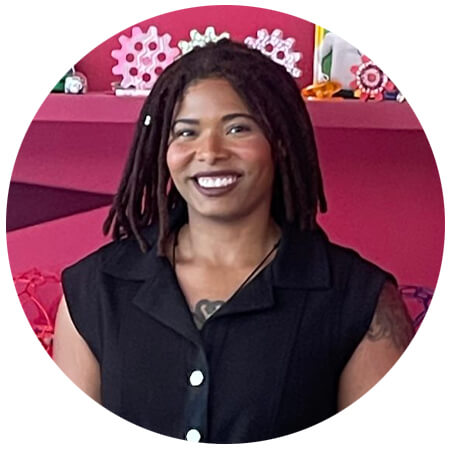
Haley Lowe, Curriculum & Instruction: My background is in biochemistry and molecular biology and I thought that was going to be the way I was going to go — STEM research. I realized that my passion wasn’t for STEM — it was STEM education. I want to focus on making it equitable and accessible, and it just seems like the best way to do it is to make sure that the instruction itself, the curriculum itself, is accessible.
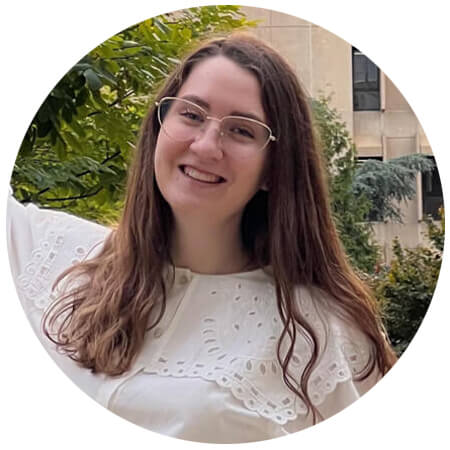
Nina Balandina, Comparative & International Education: I finished my master's here at GW in International Education and was doing my capstone project. I started thinking about how I can make a bigger impact, how I can expand the research that I was doing during my master's. I am interested in the intersection of higher education and geopolitics, and that ultimately led me to pursue my PhD.
What are you juggling on a typical day in the PhD program?
Lowe: Being a full-time student, the amount of studying time! I wake up, go to the gym, kind of get my mind right to be able to handle whatever life is that day. It’s not like an undergrad community, but there is a good sense of community. The teachers want to nurture what it is you’re trying to blossom.
Balandina: Coursework, which is typically very demanding and takes a lot of my time. I have to balance it with my Presidential Fellowship that also requires me to be very involved in developing initiatives for the graduate student community. I also work 20 hours a week in addition to two research projects with faculty. I feel like I've been learning multitasking skills every day during these past two years!
Berry: I’m in the middle of conducting a lot of interviews and analyzing data for my dissertation. I’m also working on a handbook published by Oxford University Press and working on a new book that is under contract with the University of Chicago Press. But for the past three years, I lived a double life as a full-time employee at a research organization while juggling research responsibilities and a baby!
What resources does the school provide for you?
Lowe: There’s that saying, “Look to your left, look to your right, use the people around you.” The librarians are a huge resource because in doing research, you need to know what to look for and how. Teachers are, of course, a huge resource because they know the material that they're teaching and they're teaching it better than anybody else. And then your peers—if you don't want to embarrass yourself with a professor and ask a question, you can go to them and ask first.

Berry: GW provided a wide range of professional contacts, which allowed me to get an internship at the Learning Policy Institute in my first year and an internship at WestEd in my second year, which became a full-time job. There’s a density of professional networks—the people you are studying and working with are embedded within the broader policy environment, both in the city and nationwide.
Balandina: Faculty are very generous with their time, whether it's providing feedback on some assignment or thinking about initiatives that a student wants to implement. They treat us as emerging scholars rather than students, and there are lots of opportunities for development and intellectual challenges.
What’s the most daunting thing about pursuing a doctorate degree?
Berry: This program straddles the line between the pure 100% academia experience and the pre-professional environment. It can be easy to lose track of your academic goals when you’re hitting milestones in your professional career because the academic pursuits are long-term versus immediate gratification professionally. But at the end of the day, you do have core deliverables that require a certain standard of academic quality.
Lowe: It can be isolating. You know that you’re on a journey that other people have taken, but unless you’re surrounded by those people 24/7, there’s really no guidebook. You just kind of wing it.
Balandina: We have so many opportunities, but time is limited! We have to be very strategic about what’s primary and what can wait.
What’s one thing someone should know before deciding to pursue this pathway?
Balandina: It’s a huge commitment! And it’s a long-term commitment. While the faculty are always here to support and guide you, at the end of the day, it’s you, the person, who has to make things happen and take initiative.
Lowe: You truly have to be self-starting, self-sufficient, self-motivated. You have to want this degree. Don't just get it because you think you should have it. You have to want it.
Berry: It really helps to have something you’re interested in before starting into the program. The resources GW—and by extension, DC—provides, are basically endless. And if you’re not careful, you can come out with multiple experiences that aren’t aligned with one another. Coming in with some bounds of the type of goal and the type of spaces that you're interested in will help you build a more coherent portfolio starting from the very beginning. But at the same time, be open to new experiences!
What’s the most rewarding thing about pursuing a doctorate degree?
Lowe: When you do something right and you nail it! I want to take this research and the abilities that I've learned to create, manage, and direct STEM programs that are accessible to students of color and that kind of fill that gap that underfunded school systems leave. I want to fill a place that systemic inequity creates, and I want to make sure I have the research and the backing to ensure that I do so efficaciously.

Berry: When you're straddling the line between academia and policy work, it creates a sort of feedback loop. The theoretical underpinnings of the things you're reading in classes informs how you approach your policy work, whether it's in an internship or a full-time job or whatever it is. The feedback loop between those two things made me a stronger scholar and a stronger employee at the same time.
Balandina: Our cohort is very diverse because we have students from different backgrounds, different countries. It’s very rewarding to learn about other people, about the research they are doing, and thinking about the ways you can look at your research from a different perspective. We learn not only from the coursework, from the faculty who are amazing, but also from each other. As someone who wants to be a confident and well-trained scholar whose research is not only academically rigorous but also socially and politically relevant, I’m grateful for the GSEHD experience bringing me closer to my professional and academic goals.
If you’re ready to take on the challenge of driving positive change in the field of education, consider pursuing a doctoral degree at GSEHD. Our unique programs create opportunities for cross-disciplinary research, collaboration, and hands-on experiences—alongside leading experts—exploring solutions to a range of complex challenges facing our education system today.